
Discourse Collapse
an invitation to leave The Machine

A mere six years after the founding of the Ford Motor Company which marks year zero in Huxley’s Brave New World, E.M. Forster published a prescient science fiction vision that still serves as a fine depiction of Technopoly as we experience it today. Amidst myriad criticisms of mechanism as the new world religion, “The Machine Stops” contains this gem of a rant about academic literature:
“Advanced thinkers, like Vashti, had always held it foolish to visit the surface of the earth. [...] ‘Beware of first- hand ideas!’ exclaimed one of the most advanced of them. ‘First-hand ideas do not really exist. They are but the physical impressions produced by love and fear, and on this gross foundation who could erect a philosophy? Let your ideas be second-hand, and if possible tenth-hand, for then they will be far removed from that disturbing element — direct observation.”
People in Forster’s story live their entire lives indoors, inside the titular machine, under some dubious pretense that the planet’s surface is uninhabitable. The more true reasons are comfort and ideology: we have come to revile experiences and to deify “ideas.”
The physical aspects of science fiction requiring large-scale manipulations of material and energy rarely seem to come true. We are not living in space zipping around on floating chairs like the people of Wall-E. But the development of information systems seems to have been on a predictable course for well over a century. The forum of exchange for ideas in the Machine world is easily recognizable as Twitter. And Twitter is easily recognizable as a collection of mostly people who never go outside. So to that extent Forster was right, just not in the details of what the machine would look like. No one ever gets this right, and it scarcely matters. The Machine is just for fun. The point is that we live in a tenth-hand discourse.
The Sokal Hoax
In 1994, two professors published a book. One was (and apparently still is, at time of writing) a professor of biology, and the other a professor of mathematics. In the book, they claim to want to defend science from left-wing humanities professors who don’t properly understand science; they object to what they understand of deconstructionism, postmodernism, and so forth — all the usual bogeymen. They wanted to defend the notion of scientific objectivity, and they argued that humanities and social science professors do not understand the natural sciences well enough to comment on them.
I have not read this book, but I have read many like it so I feel that I understand it already. Once you give a summary of a book like this, people easily fall into place as for or against it; being mad at feminism will always win you points. Hardly anyone needs to read it. But one man did, a physics professor named Alan Sokal.
Alan Sokal found the book very convincing, and in particular was convinced that humanities professors did not know enough about the physical sciences to understand the science they were critiquing (when they do). He believed what the book said, that the “feminist mafia” and others like them cared more about fealty to leftist talking points than about Objective Truth and so forth. So he submitted a nonsense paper to a non-peer-reviewed journal. When they asked him to revise it, he refused. They eventually published it anyway, “to encourage him.” They noted that he presents only second- or third-hand caricatures of postmodernism, mostly the kinds that were already dead by 1996 when the paper was published.
But of course: he has a second-hand (at least) caricature of the “feminist mafia,” and people who haven’t read his paper know about it and, from that, learn to also dislike and distrust the things he is pretending to criticize. Eventually references to the Sokal hoax are referencing the “attacks on science” at a very far remove: not only have they not read any of the historians and sociologists of science the original book was claiming to refute, they haven’t read that book or Sokal’s paper or any of the other papers that were published in the same edition of the journal. In this case, there are referents, if you trace back far enough; at some point there are real events and real statements that can be dug up but Sokal doesn’t know them or how they fit into their respective fields. He could have gone to the liberal arts building on his campus and talked to a feminist; I’m sure they keep a few around. What might he have learned from putting himself in this uncomfortable position?
It’s all a little bizarre since it is well-known that peer-reviewed hard science journals and academic science departments are often hoodwinked by outright fabricated data.1 However, once one has entered the discursive space of second-, third-, fourth-hand arguments about leftist bogeymen, one forgets entirely about what is true and false in the real world, and Sokal appears to be no exception to this.
The feral hogs
One of my perhaps quaint views is that journalism is a medium for connecting the public to reality; we cannot experience everything ourselves, so we become more in tune with the world by augmenting direct experience with reported experience. This is no longer what journalism is; it is responding to the hot discourse topics of the day. And it is no longer who journalists are: They are all people who have gone to school for writing, then gone straight from school to an office.
Last November, the New York Times published an article entitled “How to Deal with 30 to 50 Feral Hogs.” Recap for the younger or blessedly offline: The meme is a 2019 non-event in which a resident of Arkansas mentions local difficulties with feral swine, inspiring the usual array of reactions mostly from people with no prior knowledge of feral animals. A substantial portion of the pile-on presumed and confidently defended the position that feral hogs aren’t real, or if they are, they’re not a problem. Okay, Twitter is what it is. Surely the Times can set the record straight. It opens with this summary above the byline:
“Once a meme, free-ranging swine have become a real problem — one that has given rise to a wide array of potential solutions.”
The substance of the article seems fine, but the clickbait portion frames it with astonishing inversion of perception and reality. Hogs did not start as a meme and then turn into a real problem; the hog problem came first. But the publication cannot merely tell what is. It chooses to start with a connection to what readers know, which is a tenth-hand discourse about the feral hogs meme.
The author of this story is Emily Anthes, whose resume goes: Degree in history of science and medicine, teacher of science writing, degree in science writing, author of several books, freelance science journalist, New York Times science journalist. I don’t mean to pick on Anthes specifically; every Times biography looks like this. But it matters that the people who bring us our information have spent their entire lives in schools and offices — in The Machine. Their writing is not augmenting our breadth of experience, because the writers themselves lack experience in anything but writing. Someone else took the photos. I’m not sure she has ever personally seen a hog.
Peach Mom
Some time ago, a lady who draws comics and publishes them on her Instagram account went viral when someone took her comic from Instagram and posted it, upset by its content, on Twitter.2 The author of the comic series had posted this first in 2020, when not many people saw it, and then reposted it in 2022 when it went viral:
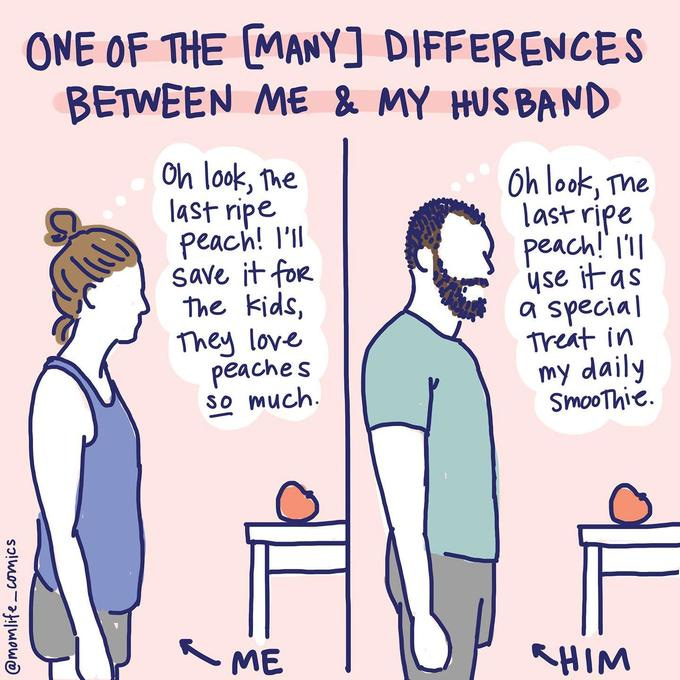
The user who posted it to Twitter in 2022 added the caption: “I wonder how many women secretly hate their husbands.” A second user around the same time added this commentary: “I for one promise to never make comics about how much I hate my spouse.” And yet another reposted it with the sardonic, “Divorcing my husband because he has the audacity to eat the food in our house.”
You might think all this is a little weird, from looking at the panel itself. Or, at least, I did. So I went and looked through the Instagram feed of this lady comics drawer to see if there was some evidence I was missing that she hated her husband. I found that she had turned “Eat the Damn Peach” into a slogan, which seemed to at least slightly complicate the interpretations of this panel I was seeing on Twitter.
But it hardly mattered. Because everyone on Twitter already had the context in which we were jointly interpreting the comic and thus the discourse about it was totally enclosed by the initial interpretations. You had to be simply either for or against the poor, long-suffering Peach Mom or Dad: pick a side. This is to be expected of Twitter, but I began to notice something strange: some “freelance writers” who have “culture critic” type podcasts and platforms were also uncritically suggesting the Peach Mom hates her husband and was part of a wave of women who hate their husbands and are hellbent on ruining marriage and so forth. Some of these women at least pretend to be some type of feminists. So, what is happening here, when someone whose job is to write about the culture uncritically accepts the wild interpretations of anonymous Twitter users as “the culture?” Did they not bother to look at the author’s Instagram and see the “Eat the Damn Peach” slogans or … ? Well, here’s one of these culture critics speaking for herself on her work process:
“I’ve always been a freelancer. I am always in my home, just sitting on the couch, tapping away.” – Kat Rosenfield 3
Ahhhh… right. Despite the Peach thing striking a chord with a lot of married moms out there (not all), she doesn’t really know a lot of moms: she knows things that happen in her tiny computer world, and so she, too, was completely trapped by the discourse as it took place on Twitter.
Literary fiction
Fiction used to serve a similar purpose as journalism, in that it served to connect people with more realities than they can experience on their own. It no longer does. We see the rise of what Sam Kriss dubs a “Woman in a Room” book:
“[...] a book in which a woman is in a room, thinking about things. [...] a lot of the time, you get the sense that people write these things because they themselves are women in rooms, not doing much, and they genuinely can’t imagine any other subject matter. [...] somehow pompous and plain all at once. Not a single glint of wit or interest.”
Now, obviously, the person in a room genre has been done well. Certainly, “The Yellow Wallpaper” is a woman in a room story, and as Kriss points out, much of Samuel Beckett’s work centers on people who are trapped in one way or another.4 But it’s rare to find someone who has themselves spent their lives in a room — in the school system, in the MFA program, then behind a desk or on a couch typing solo — who has much fresh meaning to illustrate for the world.
People enthuse about fiction’s ability to increase our empathy: by diving deep into another person’s perspective, we can learn to see the world differently and understand those perspectives, perhaps even ones that are repugnant to us. It’s true that fiction has this capacity, but for it to work, there has to be another true meaning being represented. By true, I mean story-true, not necessarily happening-true, to borrow Tim O’Brien’s useful distinction. But story-truth depends on credibility; you can have very wild things in your story that could never literally happen in real life, as long as they are believable in the world and the characters you’ve made. When the author has no credibility, whether because they haven’t done the work of building the world or character or because, and I see this often in recent fiction, they have never met a person like the one they are trying to create so the character rings utterly false to anyone who has, then there can be no story-truth.
Let’s say you have grown up middle class, or perhaps even upper middle class. Your parents are educated professionals. You do well in school; you go to college in some verdant town in the northeast. You find you have a “passion for writing.” You are accepted to the Writer’s Workshop in Iowa. This is the first time you have seen a proper cornfield. You get an MFA in Creative Writing. You move back to the northeast where you’re from, or perhaps California. You take writer-in-residence and adjunct teaching positions while you work on your first novel. Your novel is set in an MFA program that is clearly based on one of the colleges you went to; your main characters are all aspiring writers. Perhaps one of them has a boyfriend who likes to work on cars in his free time, for local color.
Well, what else would you write about? Write what you know, they say, and all you know is the life in and around various institutions of learning. Because the happening-truth you know is so limited, what you will do is work on “craft”: you will sharpen each sentence into a glittering knife-edge of wit, the semantics both precise and nuanced, the syntax interesting (although not quite so far as Cormac McCarthy’s much-studied quasi-Biblical syntax in Blood Meridian, for example). Yes, this is the way you can differentiate yourself and make a name and get published; this is something you can do. The trouble is that is what your entire cohort is doing also. All these women, they aren’t necessarily writing books about women in rooms, but they — the writers — are women in rooms (or sometimes men in rooms, let’s be equitable). And there isn’t much new to say about this, so the books are sterile.
The writers are writing not because they have some deeply felt meaning they need to convey — some fresh thought or experience or belief, which can give even sort of bad writing an edge of conviction hospitable to life. They are writing because they want to be writers, which is the wrong way round, much as the journalist is writing first because she wanted to be a journalist and then because she needs to publish a certain number of things, on deadlines. This is why LLMs can produce perfectly good high school or freshman comp essays, because those essays are also produced for the purpose of producing writing rather than out of conviction that one has something interesting or important to say.
Let us not be unfair to the MFA students, though; this has been happening for some time among literary fiction writers, leading to this wonderful joke:
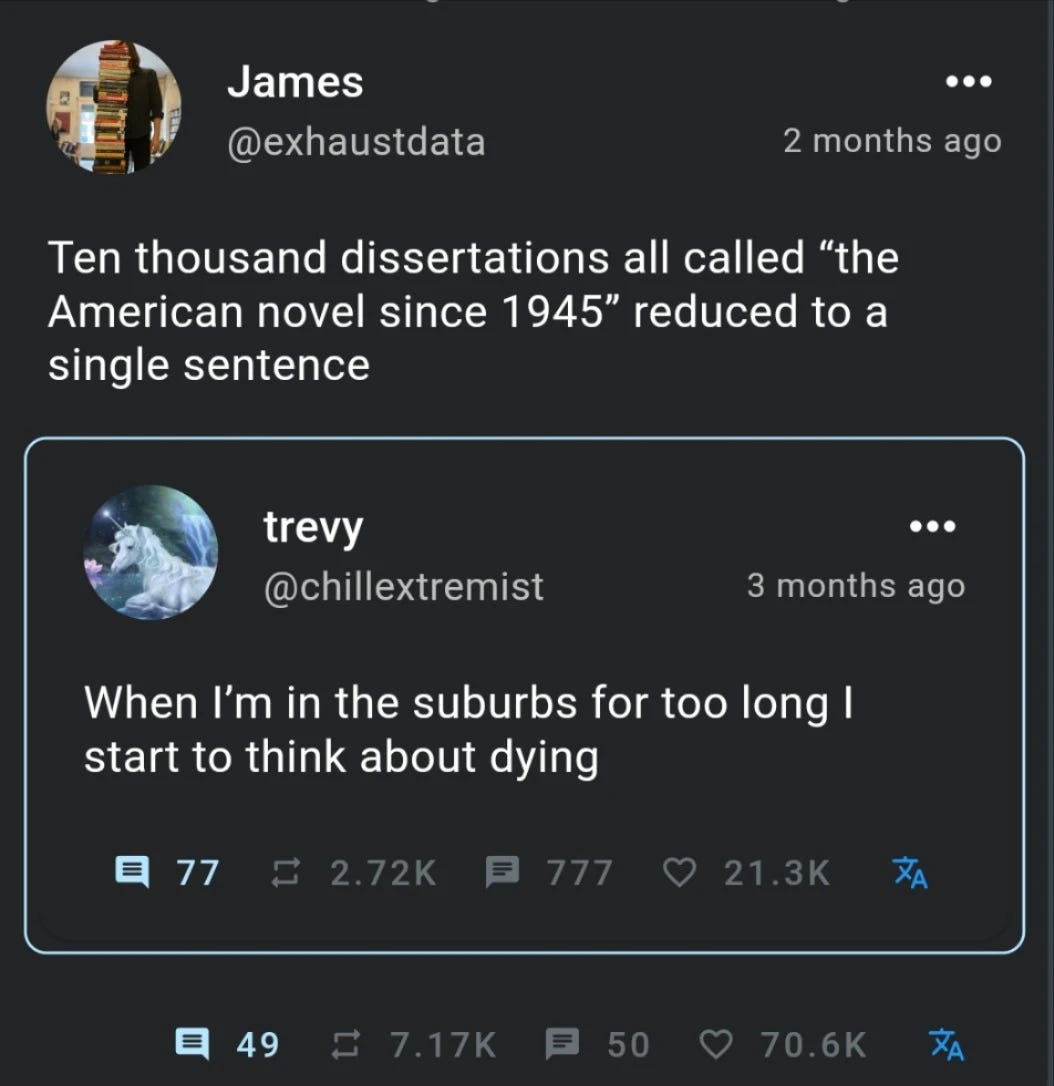
Men who find their marriages stultifying. Men who feel trapped in their nice house. Men who feel their youth and virility slipping away while they mow the lawn, like every Sunday. This was literary fiction for a long time; maybe instead of “woman-in-a-room fiction,” we should have been calling it, “man-in-the-middle-class” fiction. I wish I could say it led to less soporific navel-gazing than the current crop of middle class MFA students writing about middle class MFA students, but it really didn’t. It was just as internal to the author’s own experience, thoughts, worldview as the MFA fiction is. It isn’t that one could learn nothing from such books, but you don’t need to read too many of them to understand that the experience of being a married, middle-class man in the suburbs with maybe a child or two that you can’t relate to all that well is kind of the same from person to person. We get it. And so most people stopped reading this kind of thing, and who can blame them? There was little meaning to be found. One reason a certain type of person hangs on tightly to how great Hemingway was is that Hemingway, whatever his other faults, went out and did things. So he had meaning to convey.
What does this have to do with our purported topic? The Machine, you might think is the computer — but no! The Machine is everything that convinces you that you don’t need to go outside, that you never be made uncomfortable. The Machine tells you that you don’t need first-hand experiences. It is just as good to have fourth- or fifth- or tenth-hand knowledge, disconnected from any truth that might be out there, in the world.
The cold and giving ground
Last week the New York Times published an interactive piece entitled “Who’s a Better Writer: A.I. or Humans? Take Our Quiz.” Readers are presented with five pairs of text, each with one written by a person and the other software-generated. The reader is invited to select which “you like best.” At the end appears a bit of text that varies based on which options you picked. In one of the configurations, this text is a lecture about how people tend to say they liked something more if they know a human wrote it, the implication being that this is irrational, because all text should be judged on its own merits.
Let’s look at one of the computer-generated outputs:
We found the owl at the edge of the north field, one wing extended as if still reaching for flight. Its eyes were closed. The feathers at its breast were the color of wet bark, and beneath them you could feel the hollow bones. She asked if we should bury it. I said yes. We dug a small hole near the fence post. The ground was cold and giving.
The omission of any clarifying specificity in the selection criteria, just “choose the passage you like best,” is a load-bearing component of this article. The question contains an assertion that text can be evaluated absent of context, that from its structure can be calculated some quality score. This is essential to the thesis that a good passage is good, regardless of its provenance.
The problem, which apparently neither author noticed because they are bottled up in San Francisco and New York City respectively, is that not a single detail about this text makes sense if you’ve ever handled a bird corpse. The words are false. The owl’s wing is not extended. Its eyes are not closed. You’re not handling it in a way that you would feel the bones. Why are you digging near a fencepost? The ground is not giving; the Earth never fights so hard as when you have an animal to bury. Especially when it’s cold.
The authors’ own cherry-picked poetry example illustrates why it is rational to prefer text written by a human: because you place some amount of trust in the author any time you read. Trust for the words to be true, or at least attempt to be true, or if not that then at least trust that the author had some intent worth trying to understand. That it isn’t purely a waste of time, because it has some connection to reality. But these authors take it on faith that words alone can be significant without a signified. This is nonsense, but it is the faith of our times.
I see much speculation, either giddy or mournful, about LLM “model collapse.” This is the hypothetical eventuality in which the pristine human-written internet is polluted by such an excess of generated text that it becomes useless for training new models. I don’t think this concept matters much, because we are already there. Forster saw it beginning long before the existence of computers or an internet.
Math education
Much of education in primary and secondary school has also collapsed in on itself, especially in mathematics. I am not merely referring to the frequent disconnect between math subjects and their applications and the apparent speed and ease with which math class arrives at questions such as “what is 93/5 divided by 4/7” with utter disregard for any worldly situation that would end you up either having or imagining ninety-three fifths of something with an urgent need to know the quotient from dividing it into portions of four sevenths.
No, we have transcended this concern. What we have now is a very specific set of skills:
1.NBT.B.2 - Understand place value.
1.NBT.B.2.a - 10 can be thought of as a bundle of ten ones.
1.NBT.B.2.b - The numbers 11 to 19 are composed of a ten and some ones.
1.NBT.B.2.c - The numbers 10, 20, 30 refer to one, two, or three tens
1.NBT.B.3 - Compare two-digit numbers based on meanings of the tens and ones digits, recording the results of comparisons with the symbols >, =, and <.
Skill proficiency is measured at this granularity, and these measurements are consequential, therefore they are ends in themselves. Student performance, teacher performance, school performance, grading and funding — the things that matter — are measured by bullet points enumerating abstractions of things that matter.
Primary and secondary math teachers, accordingly, are not mathematicians. They have education degrees. They are not concerned with real things that can be modeled mathematically. Neither are they concerned with the study of how to model real world things mathematically. Their specialty is how to guide young people through this checklist that has been synthesized by other specialists.
A few of the bullet points on the curriculum are entirely out of nowhere; they’re useless, fallen off the wagon. Most of the rest have relevance but, with the curriculum broken down into such tedious detail, the purpose of each skill is only that it is a prerequisite for other skills. Why do we study 1.NBT.B.2.a? So that we can get to 1.NBT.B.2.b — and so on.
For the subject of history, there still exists an awareness that the purpose of education is to assemble cohesive pictures in the minds of students. “Do we need to memorize exact dates for the exam?” This is often asked, but is generally treated sensibly: These details are a part of the narrative texture; but what we are to take away from the class is an understanding synthesized from the narrative, not its particulars in great specificity. We habitually fall short of this aim in history class because, like everywhere else, student performance is subject to examination and statistical analysis, and so we resort to quizzing for facts.
In math, the subject’s grounding is in modeling of the world and making inferences using a model. This grounding has fully disappeared from view of students, teachers, parents, districts, and authors of standard curricula. Understanding is not an unattainable aspiration; it is out of the picture entirely. I suspect part of the reason is that mathematics lends itself toward more interesting multiple choice assessment than history, because a student may be asked to perform a calculation, thus demonstrating acquisition of a skill, which is more respectable than acquisition of a fact. Because calculation resembles thinking, we are misled to believe that exhibiting a skill demonstrates understanding in a way that reciting a fact does not. And so we are able to fool ourselves into acceptance of abstract exercise only.
Q: How can you tell when a chicken is hungry?
A: They’ll tell you.
Meaning is not a function of language; language is a function of meaning. Chickens can mean things — they can have intent, agency, desires, needs, social organization, friendships — without speaking what we think of as language. They do make noises, like the cats, like the dogs, like us. We assume they can understand each other; we assume so because we see them respond in predictable ways to certain sounds made by the others. We assume it doesn’t rise to the lofty heights of “language” and “consciousness” but I’m not convinced that we do so on any sound basis rather than mere prejudice.
Have you noticed that your cats and dogs understand that you talk? They understand where your eyes are; they understand that the noises that come out of you are generally meaningful. They understand that sometimes those meanings, the signifieds of your sounds, pertain to them. We’ve believed for a long time that it’s merely Pavlovian: they hear a sound that might as well be a bell and know it’s time for their food or for a walk or some other reward. What if we’re wrong?
One day when we had an iguana — when my son had an iguana but kept leaving to go work in the forest so I had to feed and water the lizard — it was a very hot day and the iguana had run out of water. I had an uncanny encounter with him that day. He saw me enter his room; he recognized me. He scrambled over to where his water should have been and started licking it and then looking at me, and then licking it and looking at me. That lizard could not even vocalize but still understood me as a creature who could understand such meanings as “I am desperately thirsty” and could respond to this nonlinguistic cue by giving him what he needed. If he hadn’t kept looking at me, interleaved with the licking, I wouldn’t have thought so. As it is, I think it is clear enough what he was doing.
Meaning without language is perfectly manageable for all animals, including us if we deign to pay attention. But language without significance only leads to discursive collapse. People on Twitter are arguing about Twitter with no context outside of it, so it has no meaning anymore. People are writing books and newspaper articles with no reference in the real world, only references to other texts. There is more meaning in the chickens screaming for food. Once language is only referring to itself, and not to an external referent, it is nonsense. Sure, the ground is cold and giving. Why not.
Baudrillard, without guns
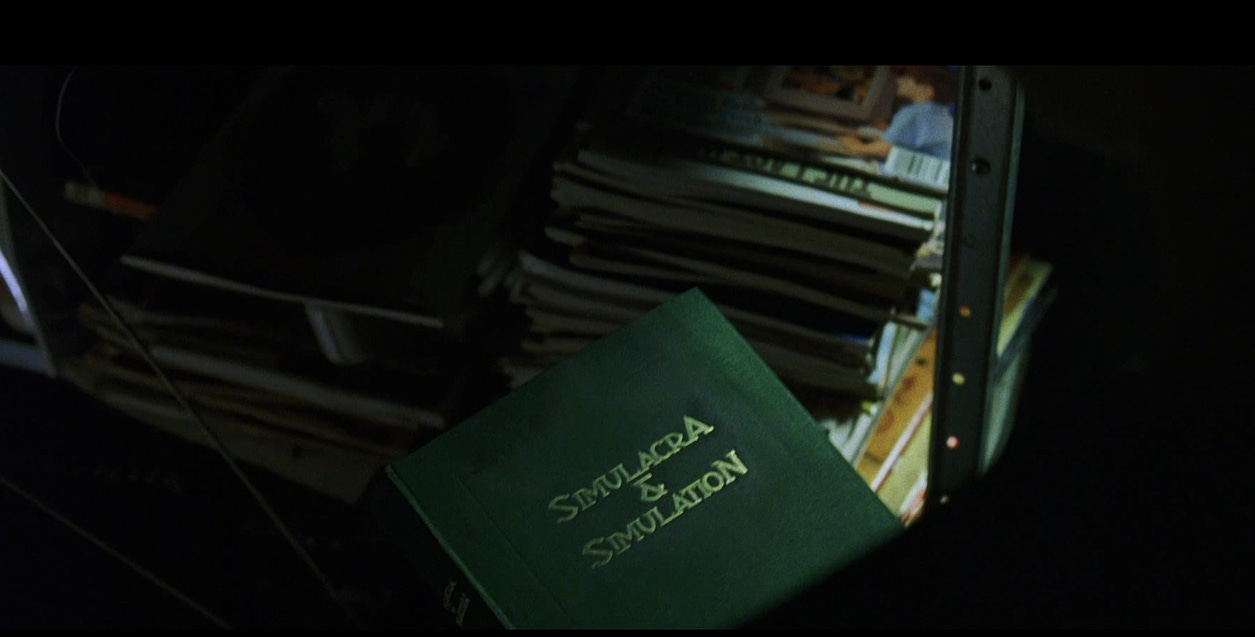
What we’re saying here is no secret; Jean Baudrillard wrote Simulacra and Simulation in 1981, for heaven’s sake, and of course Forster had already warned of this in 1909, when “The Machine Stops” was first published. Baudrillard argued that the society in 1981 had already replaced all reality and meaning with mere symbols and signs: simulacra. We live, he said, in a simulation of reality, a hyperreality in which nothing is any longer referencing real-reality. The truth of simulacra does not depend on and is not connected to truth in the world. Truth and reality, in the way Hemingway or Forster might have understood these words, have become irrelevant to the modern person’s life. This includes people like Kat Rosenfield and Alan Sokal who are trapped in textual machines, machines of abstraction, but imagine themselves arbiters and defenders of some objective truth nevertheless.
It’s become common to tell someone who is spending too much time online and hyperventilating from all the hyperreality to go touch grass. Although it’s become too much of a meme at this point to have any meaning, it is an invitation to step outside the machine and see what’s out there. I could quote you some scientific studies about how this has, ahem, been shown to lower cortisol levels or whatever, but this is one of those cases where science is trying to prove something nearly everyone once knew intuitively.
Baudrillard might be right that reality is irrelevant to the modern person’s life, but Forster was right that it is still out there and that we can leave the machine. We can’t all leave it to the same degree; many of us have to do our jobs from chairs behind desks interacting with people only in virtual space. However much such people bemoan “the attention economy” and know they are being manipulated by emotional short-form audio and video content,5 though, they generally keep choosing to stay in the hyperreal even when they are not working. They log out of their work Slack and into their hobby Discord. They stop watching human resources training videos and start watching Netflix. They stop eating alone at their desk but then order DoorDash and refuse to open the door lest the person delivering their burrito be unpleasant in some way. They will post the cute story about Kurt Vonnegut going to buy an envelope on their social media and then become very irritated when their Uber driver tries to have a conversation with them (really, how dare he, the peon!). They know they can leave The Machine, but day after day, they do not. If they were in the Forster story, they would quietly be grateful when the respirators that permit visits to the surface of the Earth are abolished, for then they would be absolved of the nagging feeling that one ought to try it.
For people who are less literate than they are — than we are — the situation is more dire, because they are mainly accessing short-form videos that are perhaps eleventh- or twelfth-hand information, which is to say, entirely made up, that also have a great deal of emotional content and are thus captivating. Such people often have few resources with which to consider whether something could possibly be connected to anything like reality. A few normal people still have some contact with the real-real, even as their interactions and beliefs about it are highly mediated by how much time they spend, say, scrolling Instagram and playing video games. There seems at this time to be little overlap between literate people who might still read significant longform texts,6 and those who have ever done real things. Each is trapped in a machine, but they are different machines, the difference between the New York Times machine and the WWE one.
Maybe direct experience of reality was never quite possible, after all (certainly it has been a matter of some philosophical debate!) but at least one could force reality to push back a little against one’s own inclination to solipsism. To feel the pushback from reality, though, there have to be stakes: reality must take something from you. At the very least it must require of you real attention. Probably it will cost you discomfort. Perhaps you will find yourself not entertained. You will find out that you were wrong about some things, and you will sometimes be frustrated by this. You will have done your best, done all that you know how to do, and still the peas won’t grow.
This is one of the things I have gained from hunting and foraging: I have paid real attention to the natural world and put myself in a position where I have real stakes. Having chickens in the backyard has changed Chris (my husband) irrevocably, although it might not have had he treated them like little inscrutable egg-laying machines. Instead he has chosen to pay them real attention and see them as they really are, both in themselves and as participants in a functioning backyard ecosystem. Keeping them, and paying them real attention, has a cost, and there are real stakes. Birds live and die based on faults of ours (not noticing a gap in the fence, for example, that has allowed a dog into the yard has cost the lives of some of our birds, and we have buried them).
Without this kind of attention and discomfort, you cannot know anything first-hand. Despite what people say, both real attention and real kindness or decency do have costs; if they didn’t, then they also wouldn’t have any value.
In “The Machine Stops,” the Machine does eventually stop, and the civilization that lived in it meets a catastrophic end. They no longer know how to subsist outside the Machine. We learn that there are still humans living on the surface of the Earth, and they survive the cataclysm, but we also learn they will choose not to rebuild the Machine. They have learned their lesson, that one cannot survive forever on tenth-hand information. Neither can we.
By far the worst of these in terms of real-world harms is the famous (and famously retracted) Lancet paper by Andrew Wakefield claiming, falsely, to have found a causative link between vaccines and autism. Many more people have heard of this and been affected by it than have heard of Jacques Derrida.
Listen, there are no social media that are exempt from this. On Bluesky, the liberals — the democracy defenders! — routinely post their fantasies about sending everyone they suspect of having voted for Trump to re-education camps. Worse, they somehow still think Marxism might end up being true. Every single time I log into Bluesky, I see people posting things that could not possibly be true, yet are treated as absolute gospel by users of the site.
I can’t really recommend clicking on that link, as it goes to USA Today whose site is absolutely littered with various pop-ups and ads, but it’s an interview with her about her latest book. She’s one I particularly remember from the Peach Mom controversy because she tweeted a photo of a peach in her house and captioned it, “husband trap.” It’s a witty tweet, and hence memorable. Unfortunately it’s very easy to make witty tweets and much harder to think about what is true and what is not.
In my favorite of his plays, Happy Days, the woman who does most of the speaking is trapped in a hill of sand. She isn’t literally a woman in a room in this case, but she may as well be.
Watching the nightly news is essentially also watching short-form audiovisual content; Instagram did not invent this. None of the stories on the nightly news are presented in the kind of depth that would facilitate understanding of the world. For more than you ever wanted to know about the ways in turning real events into short clips presented as entertainment, please read Neil Postman’s Amusing Ourselves to Death, or maybe you can find a podcast where someone talks about it.
I emphasize longform texts here for two reasons. First: longform texts require you to inhabit another person’s head, or worldview, for a long time and follow a whole narrative arc (even if it is nonfiction) through from the way they see it beginning to the way they see it ending. This can have an empathy-inducing effect; one can tell it is something real because one sometimes feels when reading them the pushback of reality that comes from knowing a mind that isn’t your own. Second, and perhaps the more important in the internet era: longform text is usually published in a format or medium that will endure, at least longer than a week and often longer than a single lifetime. That means that two people can at the very least agree on the factual matter of whether such-and-such text really says so-and-so. This is a feature of text that we long took for granted, but can no longer, because in the online things disappear all the time or are edited sub rosa so that it is always possible that the two people did not even read the same thing or see the same video. The disorienting and unreal effect this has had on the social discourse can hardly be overstated. In the New York Times “article” referenced above, for example, regarding whether you prefer the AI text or the human one, the copy that appears once you are done with the quiz is “responsive”: that is, it differs depending on how you answered the questions. I assume there are only four or five or so editions that different people might see, rather than it being infinitely changing, but nevertheless it means not everyone read and can agree to have read the same thing.
Software suffers that same problem as fiction, with people who have pursued programming and nothing else since childhood. This is why there are so many common needs of people that software fails to meet. If we observe the open world and identify opportunities in it, some of the desires we encounter can be addressed with software. But the workforce is all people working backwards: First I decide that I want to write a computer program, and then I will figure out what it shall be. This path has two destinations: Solipsistic (text editors and games) and mercenary (big tech or defense contractor).
it was interesting to read this after getting sucked into some productivity youtuber's "how not looking at my phone and staring at a wall for twenty minutes a day doubled my productivity!" self-improvement bait. (yours is better, to be clear.) the combination is nudging me back to my current Big Read, _The Challenger Launch Decision_, and perhaps away from bluesky for a few days.